Introduction
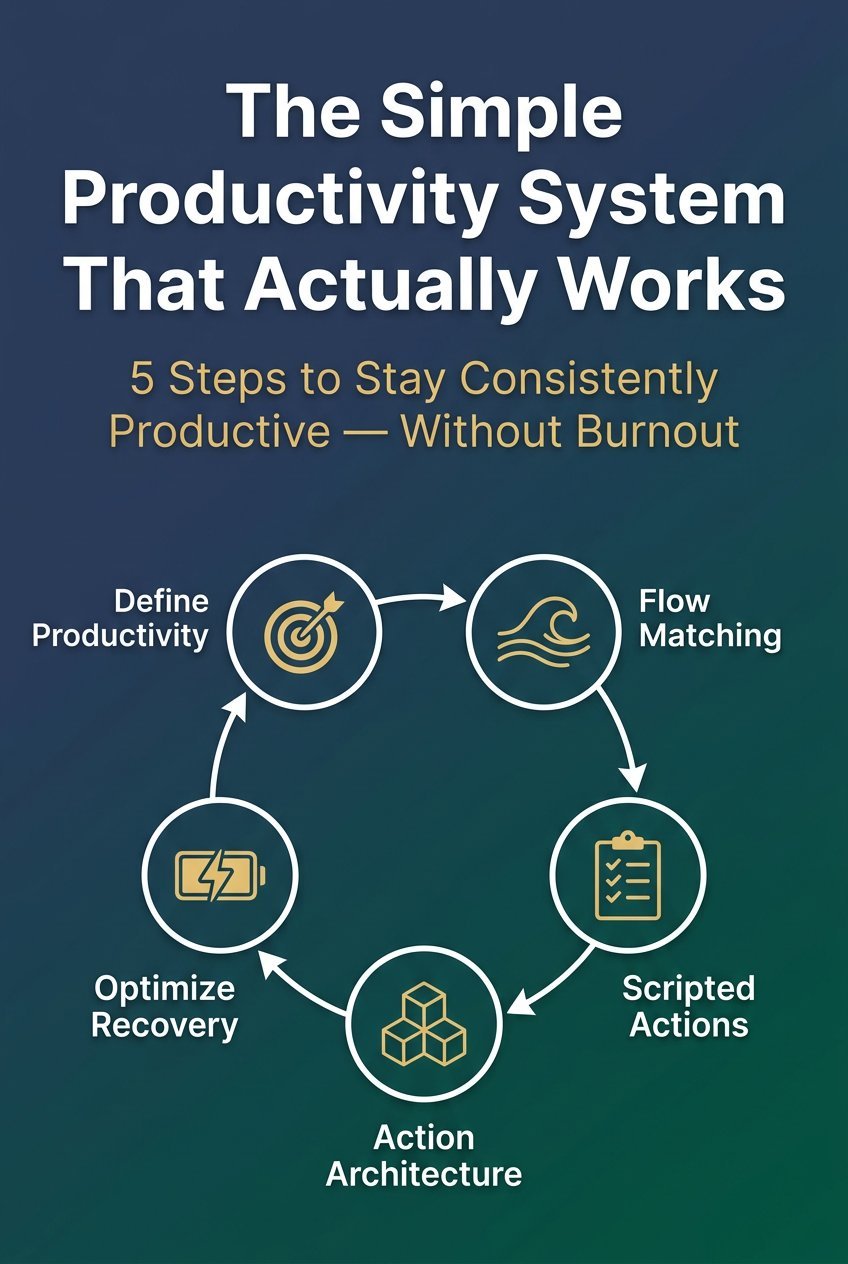
I think it can be really difficult to stay consistently productive every single day. And if you’re struggling with it, there is nothing wrong with you. It is actually a little unnatural for a human to be so productive all the time. But the good news is that there are systems of productivity that you can build that make being productive much easier. I want to share with you a productivity system that I use myself and I’ve been using for years and I also coach to my clients that is very simple. It is very doable by anyone. You can fit it into a busy schedule and it really simplifies productivity. So there are four parts to the system and I’ll go through each of the four parts and I’ll also explain a little bit about why each of those parts works and that’s important because knowing how and why something works is how you make adjustments and personalizations for yourself.
Part 1 — Define What Productivity Even Means
Start with the first part which is just to define what productivity even means. When I was in my teens and early 20s there was a lot of this productivity advice that was floating around. It was kind of the birth of the productivity guru. And what I know now is that a lot of that advice was just plain wrong or even made things worse. And so when I think about the word productivity or being productive, I used to have this connotation of being this sort of calculating super disciplined almost like a robot just being able to execute on things with no hesitation. And that’s just not a very healthy or productive way of thinking about productivity because it doesn’t really work that way.
And one of the traps that I fell into and I think it’s very easy to fall into is that it can be easy to just optimize things for the sake of optimizing. It’s like hustle for the sake of hustle. And I really don’t like that a lot of productivity advice assumes that you should be always pushing to be the best of yourself every single day, and that every second is precious that you need to sort of catch and use. That puts a lot of pressure on yourself. I don’t actually think it makes you more productive. And I think that is really the mentality that creates toxic productivity.
And so the first most important thing to lay down to be very very clear about is that productivity is just stuff that you do that gets you towards your goals. Your goals, not anyone else’s. So if your goal is just to live a chill life, that’s perfectly fine. You get to decide what is a meaningful outcome for you and therefore what is productive. Being productive is not the same thing as being busy. Being productive is not the same thing as just doing more things. It is not the same thing as having great time management. None of these things are productive unless they are helping you live your life in the way that you want to live it. Achieving the goals that are important.
So the first part about building the productivity system is just defining productivity. Most people if I say what are the goals and the outcomes that you want to achieve they can give me a list of like 10, 15 different things. Refine that down to just two or three of what you think are the most meaningful outcomes that you want to optimize towards. So for me, I want to build great learning products that help people learn to learn and use their brain in the best way. And I want to build a successful business around that. But I want to achieve that goal while enjoying the journey and not burning out and actually feeling fulfilled in my everyday life. And that’s a really important goal for me. So as a result, going out with friends, having hobbies, working out, getting enough sleep, these are all highly productive things. That’s what allows me to achieve that goal and it doesn’t fill me with the guilt that it used to fill me with when I wasn’t clear about what productivity really means for me. So that’s part one. Define productivity.
Part 2 — Flow Matching
The second part is to do what I call flow matching. And this is really simple. All you’re going to do is write down all the tasks that you need to do for the week. And next to those tasks, you figure out how complex and cognitively involved those tasks are likely to be. And the idea is that if you were to draw this graph, time on the x-axis and your productivity on the y, then as your day goes on, your productivity usually starts pretty high and then you get more and more tired. And if you do something to recover energy, then that productivity might dip again. But then as you do more thinking, you’re going to get more tired again. And this is essentially tracking your energy level throughout the day. The ability for your brain to really focus and do these complex tasks.
So if you’ve got this big task that’s really complicated, requires a lot of deep thinking, and you do it here or here, then your brain is not in a great position to do that. And so you’re going to need to spend more time doing it, which is wasted time. It’s going to be harder to get the outcome that you want. And when you do create some kind of output, the chances are that the quality of it is actually going to be lower. And so ideally, you want to do these big tasks here where you are in your cognitive peak. And when you are down here and you’re a little bit more tired, this is when you should do some more of those admin tasks, the things that don’t require so much concentration.
And this is what flow matching means. You are matching the time of the day where you are at your cognitive peak with the actual activity that you are doing. And flow matching is what dictates what your daily schedule actually looks like. It tells you which task you’re going to do when during the day in which order. And obviously within reason because you can’t necessarily control every single task that you do during the day, but for the parts that you can control, you try to abide by this principle.
And flow matching is really important because by putting your brain in the optimum state to do that task, it reduces the amount of wasted time and wasted energy. So for every hour that you’re putting in, you’re getting more return, more bang for your buck. And it helps to avoid what is the worst case scenario where out of the time that you have put in, you haven’t been able to reach the output or the result that you needed. And so now you’re in a situation where you have to compensate for that by putting in more time and that almost always does not work.
In fact, there’s this book that I read a few years ago called “Diminishing Returns at Work” written by John Pencavel. What he says is that as the amount of hours you spend on work increases per week, if this is your productivity on the y-axis, again, initially as you put in more hours, your productivity goes up, but then it starts to plateau and then over time it actually goes down. So, as you put in more hours, your productivity reduces. And so, this point at which you’re getting diminishing returns is at about 50 hours. And what he says in the book is that someone who is working 70 hours is actually only producing about as much output as someone that works 55 hours. So your productivity actually drops so sharply after 50 hours that the additional 15 hours is basically wasted time.
And I personally felt this myself because I used to be working 100, 120 hours a week working as a junior doctor while simultaneously running a business full-time. And then I quit medicine. I quit being a doctor and I spent all of that time just working on my business. But even though I was spending double or triple the amount of time, the actual business outcomes that I was able to create for myself didn’t really change by much. And fast forward to now, I work 40 to 50 hours a week. I’m not doing those crazy hours anymore at all, but I’m more productive than I’ve ever been. And that is because of the time that I’m spending, a very high percentage of that time is producing really high quality work deep in flow. And flow matching makes that process much easier.
So, we’ve now got a first part of a ritual that we can start building to form your productivity system. That Sunday evening, Saturday evening, whenever you’re going to do your planning, you start by writing down the list of tasks and then flow matching it, putting that into your schedule.
Part 3 — Scripted Actions
Now, when you do that, you’re going to have some tasks that you know historically you maybe are not going to be able to complete. It might be a little ambitious. A great one is exercise. So, let’s say Tuesday evening, you want to get to the gym after work. So, you schedule it in at 7:00 p.m. That is your intention. But then Tuesday evening rolls around, situations have changed and now you’re not able to get to the gym anymore. And so instead, let’s say you sit on the couch and by the end of the night, you’re feeling terrible because you didn’t do the thing that you set out to do that you know is good for you.
And so for those high risk tasks that we intend to do, once we put them in our schedule, we should identify them and then move on to the third part of our productivity system, which is to create scripted actions. So scripted actions are basically predetermined decisions that you’re making for yourself. And it says if X then Y. So you scheduled an exercise on Tuesday evening. And so what we’re going to do now is think about all the barriers or the conditions, the things that could happen that prevent you from acting on that intention. These are predictable risks. If I finish late from work and therefore I’m not able to pick up the groceries to make dinner in time and that’s a risk and if I can’t make dinner in time, I’m going to choose to just make dinner and then not go to the gym. Then we would say if I finish late from work and can’t pick up the groceries to make dinner, then I’m going to just get takeout that day. You’re making that decision in advance, which in this example is because on that day going to the gym is more important for you, you would deem that as more productive and again that is relative to your goals and you would do that for the other risks that you can think of and by creating these scripted actions we’re setting ourselves up for success.
The research shows that when we use scripted actions the gap between intention and behavior, i.e. you intending to do something and whether you actually do it or not, that gap reduces by half which basically means that it is twice as likely that you will do what you set out to do. And this is without becoming less busy, reducing your level of responsibility. It is just by having these decisions made upfront.
And the reason scripted actions are so powerful is the same reason why you get diminishing returns when you put in too many hours with work. It’s the reason why you have cognitive peaks and troughs in the first place. And all of this comes to something called the prefrontal cortex and specifically a phenomenon which is prefrontal cortex fatigue. So that’s PFC fatigue. Your prefrontal cortex is the part of your brain that is involved in decision-making and planning and executive functioning and coordination. So this is the part of the brain and the human that is more developed than any other species. Most of the really complex big tasks that you need to schedule in your day that you’re flow matching, these require prefrontal cortex involvement. And your prefrontal cortex is very energy consuming and it fatigues very quickly.
And the reason I’m teaching you about prefrontal cortex fatigue is that once you learn to recognize this, this is really what makes productivity easy. When you enter into prefrontal cortex fatigue, you will notice a few things. Because it is involved in decision-making, you become more reluctant to make decisions. You become increasingly lazy. If you’re pushing through and still trying to work despite being in PFC fatigue, the quality of your work is going to go down. And that is a reason why when you push through too many hours, you get this diminishing return on your output because the prefrontal cortex which is responsible for that output is no longer really functioning properly. It’s got nothing left to give.
And so we can say that your productivity is strongly influenced by your prefrontal cortex. And so with scripted actions, what we’re trying to do is instead of saying, “Hey, we’re at the end of the day. It’s Tuesday evening. You’ve spent an entire day at work making decisions and solving problems and using your brain. Your prefrontal cortex is fatigued. And now we’re coming home. We’re coming home late. We didn’t get the groceries. And now we have to decide and coordinate again. Are we going to get takeout? Can we afford to get takeout? If I make dinner now and do a grocery run, am I going to get time to go to the gym? If I don’t go to the gym today, when will I make it up?” This is a lot of complex decision-making we have to do, and your PFC is already fatigued. And so if you’re in that position trying to make those decisions with that state of your brain, then you’re going to feel lazy and reluctant. It is very difficult to be productive when the engine of your productivity has shut down.
It is much easier to have made as many of those decisions upfront as possible with our scripted actions so that when Tuesday evening rolls around, we simply observe what has happened. I’ve come home late. I already decided what I’m going to do. I’m going to get takeout. You just have to execute. The PFC does not need to be involved in that. It doesn’t increase its level of fatigue.
But now we have three parts of a productivity system, right? So we have a very clear goal of what we’re optimizing towards that might update over time. And then on a Sunday evening, we are writing down all of the tasks. We’re figuring out how much concentration and focus it requires. We’re scheduling that. We’re identifying high-risk tasks and we’re creating scripted actions for them. And when you do this a few times, this process becomes very fast because you tend to have the same scripted actions because the risks are predictable and the tasks repeat. But by taking the time to do this upfront, we are setting ourselves up for success for the entire week.
When I’m coaching someone and they describe this daily grind of going uphill to create productivity every single day, then that’s a red flag. That tells me that they’re not setting themselves up properly because most of the productivity throughout the week is determined by the decisions that you make days ago.
Part 4 — Build Action Architecture
Now speaking of setting yourself up for success, moving on to the fourth part of your productivity system, which is to build action architecture. So when I was 18 and first getting exposed to all these thoughts around productivity and what it means to be productive, a lot of the discussion was centered around motivation. And the way that I understood it at the time was in order for you to take action that has to be preceded by motivation. And so you wait around waiting to feel motivated in order to do something. And a lot of the productivity advice was around increasing this motivation so that you can take this action. So I used to watch motivational videos and read inspirational quotes and really try to hype myself up all the time.
But when you look at the research in behavioral science, you see that motivation actually only accounts for 20 to 30% of whether people actually take action or not. And really disciplined people that have a lot of self-efficacy, they do not have more motivation, they just need less motivation. So, how do you need less motivation? Well, the answer that most people give is, well, you have to turn these behaviors into habits. But the thing is it’s actually really hard to build habits because if I had just one thing that I don’t like about Atomic Habits that James Clear wrote is that he doesn’t really emphasize the fact that most complex behaviors are not habits.
So for a moment don’t think about the word habit. Instead, I want you to think about the word cue because building action architecture is all about cues. A cue is a trigger that you interact with in your environment that prompts a certain kind of response. And that response hopefully is the desired action or behavior.
So, let’s say that you want to go for a run. Well, a cue could be having your running shoes right by the door, packing your running clothes so that you can get changed straight after work, creating a nice tidy workspace for yourself that’s free of distractions. What we want to do is we want to create as many cues as possible that lead to a desired behavior while removing the cues that take us away from that behavior. These are our distractions.
In my experience coaching people on productivity, the most disciplined, most productive people that I work with, they take this really seriously. When they intend to do something and it doesn’t go as intended, they don’t internalize that as, oh, here’s another example of me failing. Here’s evidence of the fact that I’m not a productive person. They use that as feedback to ask themselves, what was the cue that was present that distracted me and pulled me away? How could I remove that? Or what is a cue that I could place that was missing that would make it easier for me to naturally go towards that behavior? And they think about this a lot whereas people that chronically struggle with productivity they do the bare minimum for this they set up a few cues it doesn’t work and they say it’s not working for me.
But the process of optimizing your environment, creating the right cues, creating the architecture that allows you to take action, this is a process that takes iterations, weeks, maybe months of experimenting and reflecting so that it eventually gets easier and easier and easier to just naturally become productive. And by doing this, we are shifting the focus from motivation dependent productivity to cue dependent productivity.
And it is crucial to make this shift because only when you have cue-dependent actions are you able to build habits. This is what I was mentioning before in that most complex behaviors are not habits. If the behavior that you want is to eat more healthy or to exercise more, these are not single behaviors. These are a series of complex decisions and consideration and multiple behaviors that come together and they come together differently at different meals and at different times and depending on your energy level. Your brain can’t take all of that and just turn all of that into a habit.
From your brain’s perspective, in order for something to become a habit, there has to be a very clear cue and a response to that cue. So, while it might struggle with “become more healthy” or “exercise more”, instead turning that into “when I walk out my door and see the pull-up bar attached to my door frame, I’m going to do five pull-ups.” That can become a habit. It could even be an emotional, psychological cue. “When I notice that I’m feeling lazier, my prefrontal cortex is more fatigued. Instead of what I normally do, my existing habit, which is to sit on the couch, scroll for 5 hours, and feel like crap. Instead, I’m going to go for a short walk. I’m going to do a 3 minute stretch.” You can see that the pairing of the action and the cue is very clear and very specific.
And so the time it takes for you to develop a habit is strongly influenced by how clear and specific that cue-response pairing is. When you have multiple different cues all going towards slightly different responses, your brain doesn’t really know how to turn that into a habit. And so it takes a much longer time for the habit to emerge, if ever. So by focusing on building this action architecture and moving from motivation dependent to really thinking actively about the cues then we start naturally forming much clearer and tighter cue to response pairings which means that these become habits much faster.
And once something becomes a habit it does not use the prefrontal cortex anymore. It’s a different part of the brain. So now it no longer requires your prefrontal cortex to have the energy for you to be productive. That productive behavior is running on autopilot. Most people understand that theory. What they don’t understand is the requirements to build the habit in the first place, which is this cue-response pairing.
So what does building the action architecture look like as part of your productivity system? So this means that on that Sunday evening, you’re writing down your tasks, you’re flow matching, you’re creating your scripted actions, and you’re also asking yourself, what are the steps between intending to do it and actually doing it? And how many of those steps can I do? Can I put in place? Can I make it easier for me to do right now? You identify the distracting cues, you go and remove them. You identify good cues that stimulate the behavior, you go and put them in place, or you schedule time in your calendar to set yourself up for that.
Remember that a large part of the productivity you feel today has been dictated by what you did to set yourself up for success in the days before. And again, as you continue to do this week by week, it gets faster and easier to set up that action architecture and plant those cues because those tasks and those habits that you’re trying to build, they’re usually repeating. So, you already know what you need to set up and those cues are already there as long as you didn’t move them away. They still exist and all you’re doing is you’re refining it. You’re adding more cues. You’re tweaking it a little bit and optimizing it week by week. And so, this entire system takes half an hour. You use it once a week and it makes being productive for the rest of that week so much easier.
The Sneaky Fifth Part — Optimize Your Recovery
Now there is sort of a sneaky fifth part of this productivity system which is what happens if our prefrontal cortex never recovers. What happens if our graph of productivity doesn’t look like this where each day we’re tired and we go to sleep and we wake up rested and then we burn through our energy again. What if instead it just looks like this and we can barely remember back when we were actually energized and we didn’t feel fatigued and we didn’t feel lazy. What that usually means is that you have been in a chronic state of prefrontal cortex fatigue and that usually happens because of inadequate recovery.
And so the fifth part of the productivity system is optimizing your recovery. The easy answer to give is to say just get more sleep. But actually prefrontal cortex fatigue does not necessarily recover with sleep. This is why even despite having great sleep, you may still feel tired. And there is a science to recovery. There is a checklist of things that if you do allows your brain to see that as valid recovery and even when you can’t get enough sleep allows you to recover. But it’s too much to get into here. If you want to learn more about that, there are many resources available that break down the science of recovery in much more detail.
Conclusion
So, this entire productivity system takes about half an hour. You use it once a week and it makes being productive for the rest of that week so much easier. Thank you so much for reading.