Introduction
How do you start feeling overwhelmed and confused when you’re thinking about something tricky? You know that feeling when you’re trying to make a difficult decision or you’re working through a particularly complex problem and there’s so much going on that you don’t even know where to start. In those situations, how do you get to the right answer quickly without missing something important?
I’m a learning and cognitive performance coach and for the past 14 years, I’ve taught tens of thousands of people how to use their brain the way that their brain actually likes to think. And today I’m going to share with you nine habits for clearer thinking that make you a better decision maker and a better problem solver. And I wish I knew these sooner.
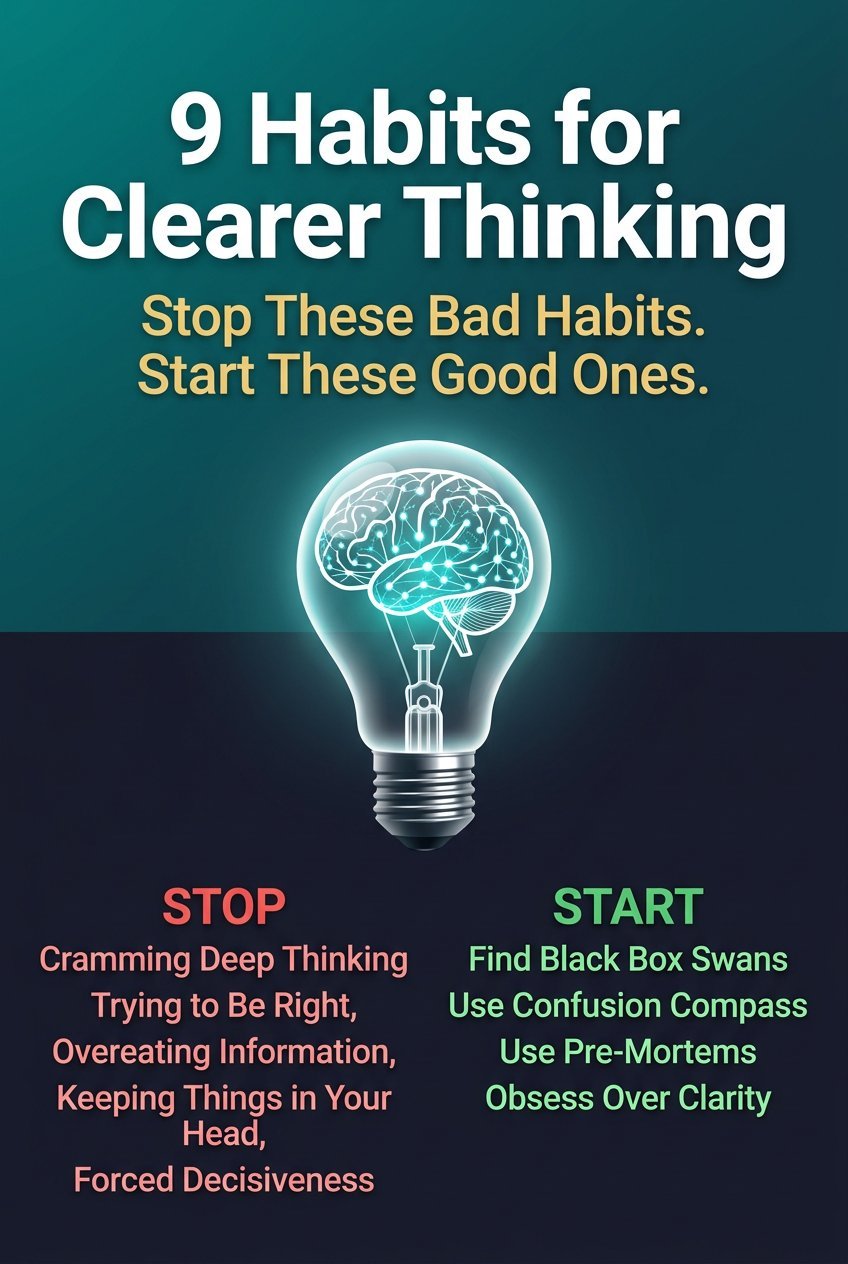
I’m going to break this down into two categories. First, bad habits that are really common that you need to stop. And then the second part, good habits that you should start that most people don’t do.
Bad Habit #1 — Stop Cramming Your Deep Thinking
Over the years, especially as my personal and professional responsibilities started increasing, I found it harder and harder to have these nice uninterrupted periods of time where I can really sit and think through the problems that I’m facing. And one thing I noticed about myself was that I tended to lean towards executing on things more than thinking about things. And I notice this a lot with a lot of my clients, especially those that have a track record of being high achievers and high performers.
But the thing about most complicated problems or difficult decisions that you really need to think clearly about is that it’s rarely bottlenecked by your ability to execute on things and it’s more bottlenecked by how clearly you can think through it. If you’re not really actively carving out the time and space to do this deep thinking and instead you’re relying on just naturally becoming a little bit less busy and using that opportunity to do more thinking, it’s not really a predictable or sustainable way of doing things.
I found that a lot of the time when there was something really complicated for me to try to think through that felt really overwhelming and really confusing, it was only overwhelming and confusing because I was trying to think through it in like 5 to 15 minutes. And so a practical takeaway for you and one thing that I started implementing in my life is actually putting aside 30 minutes to an hour in the evenings. Doesn’t have to be every day, but certainly when there are these pressing problems that you’re trying to think through. And actually dedicating that time just to sit there with a pen and paper, just freely thinking about that problem and letting yourself put those thoughts on paper. So just not cramming your deep thinking becomes one of these pretty easy no-brainer changes that you can make. That actually gives you the opportunity to think more clearly.
Bad Habit #2 — Stop Trying to Be Right
This one is really a game-changer and it can be difficult for some people. But when you’ve got a confusing, overwhelming situation that you’re trying to think through, trying to think through everything in the right way and come to the right conclusions all of the time can make it much harder to think clearly.
And understand this, it’s useful to actually break down the anatomy of confusion. So when we feel confusion, what is our brain actually sensing? What does our brain detect that triggers this confusion feeling? Well, most of the time it actually boils down to just the fact that there is lots of stuff going on. So if each of these dots represents some kind of factor or variable, then a simple not confusing situation is when there’s only maybe one or two of these dots. It’s really easy for our brain to think about this. But as we introduce the number of factors and variables for our brain to keep hold of, it becomes overwhelming.
But it’s not just overwhelming because there’s lots of things to think about, it’s because we have an understanding that these things also influence and relate to each other. And the confusion comes from the fact that you know there is some kind of relationship between them, but you don’t really know what those relationships are. You know they’re connected, but you’re just not quite sure how. And in cognitive load research, we call this multiple element interactivity. There are multiple elements. Each element is a factor, a variable, a principle, or a concept that affects your decision-making. And those elements interact with each other. And that overwhelm, that is what creates the confusion.
But the issue that stops us from thinking through this clearly and actually seeing what is the right way to think about this, is the fact that when we don’t know how all of these things connect together, we believe that we need to figure it out and get it right. We need to correctly map how all of these factors influence each other first in order for us to make our conclusions or decisions or solve that problem. And while it’s true that we eventually need to be right about the way that we think about it, we don’t need to be right straight away.
And this is really the habit of really clear thinkers that are able to just sort of cut through and see those patterns and see how the dots connect much faster than most people, is that they’re not trying to be right straight away. Instead, they’re going to make predictions. They’re going to make guesses and let themselves be corrected later on. So, they might look at these and say, “Hey, well, I think this one and this one are probably connected in this way, and maybe it’s connected like this, and like this and maybe there’s something like this.” All you need is for your brain to have some way of making sense of this. And even if the way it makes sense of the situation is not correct, just taking a guess at how it all connects together unblocks your brain and stops it from just continuing around in circles over and over again.
And so, the obvious question with this is, “Well, if you just take a guess at how everything is important and how it all connects together, and you are wrong, which you’re probably going to be cuz you just took a guess. Then, doesn’t that mean that your solution, or your decision, or the conclusions that you come to are also going to be wrong?” And the answer is yes, if you stop there. But, you don’t stop there. Once you have a way of thinking about this, once you’ve taken your guess at how all these factors relate to each other, you can then move forward and get more information and data about whether you were right or wrong.
So, let’s say that you’re trying to solve this really tricky problem, and you think that there is this certain way of solving it. You’ve created a model for yourself, which you’ve just taken your best guess at. You can then try to apply that model to solving the problem and see whether that seems right or wrong. Or perhaps, by forming this model, you realize that there are a couple things that you want to learn a little bit more about. So, you’re going to go and learn about that. In either situation, you’re going to get information about how your way of thinking about it, how your guess was correct in some ways and incorrect in other ways. And that feedback allows you to go and correct your earlier working model.
So, you might have realized, “Hey, yeah, this relationship is correct, but actually it goes back and forth. And this one that I had is actually wrong, and actually it’s more like this one.” And so, now you’re not working with three to five different variables that all connected together in some confusing way. Each error that you made in your guess becomes a single focused thing for your brain to think about and improve. And over multiple iterations of feedback, every time you do that cycle, you get closer and closer to having an accurate, correct view of the situation.
And so, people who struggle with thinking clearly, they don’t want to make these errors. They’re trying to be right straight off the bat. People that are very efficient with thinking clearly are focused on just being wrong quickly and up front and engaging in as many of those feedback cycles as quickly as they can.
Bad Habit #3 — Stop Overeating Information
So, if we go back to this anatomy of confusion, one of the ways that we habitually respond to this confusion is to just learn more. And this often means reading more, asking more questions. And that’s not always a bad thing, but it can make it harder to think clearly about the situation. And this is because when you’re confused about something, it’s often not because you lack information, but because you don’t know how the information you already have connects together to form a big picture.
And so, if there are five important things for you to consider when you’re thinking about this problem, it’s hard to make a decision about it because if you change one of those variables, you don’t know how it’s going to impact all four of the others. And so, if you’re feeling confused, and your response is just to try and learn more or think about more factors and variables, all you’re doing is going from five things to think about to 10 things to think about. You’re actually giving yourself more things to be confused about.
When you’re feeling overwhelmed and confused, the thing that allows your thoughts to become more organized and for your thinking to become clearer is actually digesting what you’ve already got to work with, not eating and consuming more information, which is only going to add to your existing confusion.
And so, the practical takeaway for you is that when you notice yourself feeling confused and feeling overwhelmed, and you notice that you’re trying to resolve that just by learning more, stop yourself. And instead, do habit number two, which is make some guesses about how you think it might be connected together. Even if it’s wrong, just get to a point where it at least feels more organized.
Bad Habit #4 — Stop Keeping Things in Your Head
When I was in my teens and early 20s, I thought that mental sharpness was about being able to think about a lot of stuff in your head. I wanted to be that person who can take something really complicated and just sit there and nod sagely about it and just have answers appear. But, that’s not really how the brain actually works. And one of the strategies that really tripled, even quadrupled my ability to think clearly and quickly about things, was to stop trying to hold on to all of this stuff mentally.
I trained myself in a new habit, which was anytime I have the thought, “Hmm, this is tricky. I’m having to really think about this.” Straight away, I will reach for my notebook and start mapping out my thoughts. If I have these five points, and I’m thinking, “Well, maybe it’s connected like this and like this and like this. Well, maybe it’s connected like this and like this and like this. Well, maybe actually I need to group these two things and actually it’s, you know, these things connected to each other like that.” I’m not going to even try to do this thinking in my head. I’m going to literally draw it out and visualize it.
And by externalizing your thoughts, what you’re doing is you’re optimizing what’s called your working memory. In neuroscience, working memory is basically the workbench of where your brain does a lot of information-related thinking. So, if I get you to do some mental maths, like 12 times 13, that mental calculation that you’re doing, where you’re calling on your knowledge of multiplication and arithmetic, that’s happening in your working memory. If I ask you, “What did you have for breakfast yesterday?” then that knowledge is coming into your working memory in order for you to be able to describe it to me. So, anytime you’re trying to apply your knowledge, like teaching something or building something or recalling and explaining or anytime that you’re trying to understand something new and learning things, all of that work is happening in your working memory.
And the thing about your working memory is that it is very limited and very fixed. I mean, all of our working memory, the human working memory, not just you in particular. And really effective thinkers optimize how they use their working memory. Because it is so limited, it’s also very easily distracted and hijacked. And what the research tends to show is that you can only really hold on to between three to seven different things in your working memory at any given time.
Now, you might be thinking, “Hmm, three to seven? Well, I mean, in this example that you’ve been giving this whole time, there’s only one, two, three, four, five things. So, five things should be something that I can perfectly do within my working memory.” No. Remember what I said, the confusion comes from not knowing how these five things connect together. If you have five individual things to think through, there are over 1,000 permutations of relationships. In reality, maxing out your working memory looks like this. “Hey, here’s one factor. Here’s another factor. Maybe they could be connected like this. Or maybe it’s connected like this.” Boom. You’ve maxed out your working memory because you have now one, two, three, four, five things to keep track of. Two points and three directions of relationships.
For a topic like this, that would be the equivalent of asking, “How is confusion related to your ability to think clearly?” There’s only two concepts there. But if you really take the time to try and think about how confusion and thinking clearly are related together, you’ll find that your brain is doing a lot of work. And that work that your brain is doing trying to figure out that relationship, that is how you create organization in your thinking. That’s where the clarity actually comes from.
So, you want your brain to be doing that. You want it to be really focused on doing that kind of thinking. And it cannot do that thinking if it’s distracted just trying to remember the thoughts that you had before. So, forget about mental sharpness, just put it on paper and stop trying to do it all in your head.
Bad Habit #5 — Stop Forced Decisiveness
When I was growing up, I always had this concept that it’s good to be a really decisive person. And what I confused was that a good thinker is naturally able to come to decisions quickly because they know how to think about it. They are not doing those bad habits that I’ve already mentioned. When I was younger, I didn’t really have the tools to make good decisions. I didn’t know how to think through these things and allow myself to navigate through that confusion in a productive way. And so, instead, I just thought, “Well, I need to make decisions more quickly.” And I would actually force my decisiveness.
And while that’s not a bad thing if you’re trying to decide what to eat for lunch and there’s 10 different menu options, the decision that you make there is not really going to be consequential. But if it’s a really big decision, and let’s say there’s hundreds of thousands of dollars or your career or a business strategy that’s on the line, then making the decision quickly is not as important as making a good decision.
And the reason this is so dangerous, I think, as a habit is that when you’re met with this confusion and there are all these things going on, it is much, much faster to just not think about some of these variables. If the reason we’re confused is that there are five different things that are confusing us, then we can just tell ourselves, “Hey, well, maybe this one, this one, and this one are not as important.” And now we just have to think about this. We’ve gone from a confusing, overwhelming situation to a really simple situation, and we’re able to come to a decision very quickly.
But, simplifying this situation to just these two points may not be accurate. When we do this kind of thinking, where we’ve basically just locked in some kind of decision or conclusion by oversimplifying something, because we don’t know how to think through this confusion, I call this an ETC decision. I once read that when you’re writing lists of things and you can’t think of more things to write on the list, you just write etc. because you’re just lazy. And therefore, the ETC stands for end of thinking capacity. And this is basically the situation. There’s something that’s complicated, but we’ve reached the end of our thinking capacity about this, so we just tell ourselves, “Okay, maybe it’s simpler than that.” And we just arbitrarily lock in some kind of conclusion. That’s an ETC decision.
So, as a practical takeaway, if you’re trying to work through something complicated and you need to think clearly about it, if you arrive at a decision and it feels really simple, ask yourself, “Is this just an ETC decision, or have I properly thought through it with the respect that it needs?”
Good Habit #1 — Start Looking for Black Box Swans
So, those are the bad habits that you should stop. Now, these are good habits that you can start that make it easier for you to think clearly. The first good habit is to start looking for black box swans.
Now, if you’re not familiar with black box or black swans, I’ll quickly explain it. Black box refers to any time that there is some kind of input and an output and there is some kind of process that happens in the middle that we don’t really know much about. This is the black box. So, with thinking, a good example of this might be that we know that we have to put time thinking. We need some kind of information about the problem and the output of this is some kind of solution or maybe some kind of decision that we’re making. But, the thing that allows time and information to become a good solution and decision is what happens inside the black box. This is our thought processes or frameworks or mental models that we’re using.
And if this stays inside the black box and we don’t really know what the right thought processes or frameworks to use are, then often what happens is that we have to put in a lot of time and we need a lot of information to try and increase the quality of this output. Whereas, when you know what’s inside this black box really well, then you can do more with the time and information that you have.
Now, on the other hand, a black swan refers to something that is currently unknown to you, but may be significant in the way that you think about something. So, unknown plus significant. It comes from this story where somewhere, I think in Europe, they used to think that no such thing as black swans existed and so the word black swan used to mean this thing that doesn’t exist and then eventually explorers realized that, “Hey, there are some countries out there that do have black swans.” And then black swan came to then be known as the thing that you think doesn’t exist, but it actually does, you just don’t know about it.
So, let’s say that you are thinking about a job change. Thinking about moving to another company. And you’re really thinking about this decision, a black swan might be not knowing that when you move to this new company, your manager and all the other people in the team are going to leave and you’re going to be left there by yourself. That is information that you may not have had access to, and if you did know that, that would have significantly altered the decision that you make.
And what I found to be really useful is to look for both of these things, especially when they occur together. And this is basically what I call a black box swan. It is a black box inside which there is a black swan. In other words, it is a process that you use to achieve some kind of output that you don’t know a lot about, but there are parts of this process that if you knew about would significantly change your strategy or your decision or the way that you would approach this problem.
And a great example of black box swans are performance reviews or switching careers or trying to get recruited. When I was a doctor, back then what I was really interested in was getting into eye medicine and eye surgery. It’s called ophthalmology. And I knew that the inputs were going to be spending time getting really good, you know, having some certain levels of competence and having papers of research published. And the output that I wanted was to be accepted onto a training program. It’s very competitive and there are limited seats. The black box was the actual selection process and criteria. When you have 10 different people all with publications who have all spent a lot of time, who are all pretty competent, how do they actually pick who gets through to the next round?
And so I did some searching and I spoke with people and I learned that there is certain criteria that need to be met, but the black swan that I didn’t know about was how important it is for certain people to just know who you are, have seen your face, and have interacted with you. Those are the people that are actually vouching for you in closed doors. And what that means is I can’t just focus on getting things published and becoming competent. I need to go to those conferences and try to present and have those proactive conversations with certain people so that they know who I am. So that’s an example of an important variable that significantly changes my approach or my strategy inside a process that was pretty opaque.
And I find that sometimes it’s an effective way of navigating through confusion and figuring out really where you need to focus your learning on by asking yourself, what is the outcome that I’m trying to reach right now? And what are the processes and mechanisms through which my time and effort is going to reach that outcome? And look for those processes and mechanisms that you can’t really explain. You don’t really know how your time and effort is going to translate. That’s a black box. Unpack that black box. Learn a little bit about what that process involves and specifically look for those factors that once you know about changes the way that you go about solving this problem, making that decision, or executing on a strategy.
And I can tell you that there are business mistakes that have cost hundreds of thousands, if not even millions of dollars, that could have been avoided if I had looked for these black box swans more proactively.
Good Habit #2 — Start Using a Confusion Compass
This is honestly one of my favorite techniques for cutting through confusion quickly. It’s incredibly simple. Every time you feel confused, ask yourself why. Returning our confusion into a question.
A lot of the time what happens is that we feel this emotion of confusion straight away. As soon as we recognize there’s a lot going on, they connect to each other in some kind of mysterious way, bam, we’re hit with this emotion of confusion. And habitually we respond to this by oversimplifying it, making an ETC decision, or just learning more about it, which actually makes the confusion worse. Instead of doing that, just look at that confusion, feel the emotion, tell yourself there’s nothing wrong with feeling confused, and say, “What am I confused about specifically?” Turn the emotion of confusion into a cerebral focus. And by doing that, you create a list of questions that if you were to go and find the answers to these questions, your confusion naturally dissipates.
One of the worst habits that many of us have is treating confusion like the enemy. Confusion is a form of intuition. It is your brain telling you that there is something to figure out, and that thing is in this direction. Go to the confusion. Turn it into a question.
Good Habit #3 — Start Using Pre-Mortems
And a useful way that you can think of some of these questions is good habit number three, which is to start using pre-mortems. Traditionally, the word post-mortem is a technique for when someone has died and you examine the body to see what the cause of death might be. A pre-mortem, in the more general sense, this word has now been used to analyze why something has gone wrong. And so, a pre-mortem is before you do it, assume it went wrong, and ask yourself, “If it goes wrong, why would it go wrong?”
This technique is really useful because it helps to combat some of our biases in decision-making. It reduces motivated reasoning, which is when we think about and process information to align with something that we’re motivated towards, and it helps us to see the situation a bit more objectively.
For example, if we’re thinking about moving to a new city and starting a new job because you’re really burnt out in your current job, and the new place says that after 6 months you might get a pay rise and the team seems really lovely over the interview, then motivated reasoning might kick in because you’re already burnt out and you’re excited about this new change and you tell yourself, “Hey, the kids are still young. If we move cities, they’ll still be able to adapt and plus I’m going to get a pay rise and it’s going to make me more than I’m making right now and this team would be so much better to work with than my current team.”
But if we do a pre-mortem and we assume, “Hey, let’s assume that we moved. We started this new job and we hate it.” Why might that be? Well, maybe I actually just hate living in that city. Maybe the kids don’t adapt because they’re in this formative time of their life and these relationships are really hard to rebuild. And hey, now that I think about it, they said, “You might get a pay rise after 6 months, not you definitely will.” Maybe the team is not that great to work with. After all, I’ve only spoken with them for 20 minutes. And now that I think about it, do I really want this job or am I just sick of my current job?
So, you can see how forcing yourself to assume a worst-case scenario and working backwards helps us have a more balanced and objective perspective. Often it allows us to see solutions that are not so black and white. Like maybe there are things that you can do in your current job, in your current city that stop you from feeling so burnt out or maybe there’s a gradual transition that you can make. It deromanticizes this new shiny decision.
And I really love pre-mortems because they allow you to think more clearly so quickly. It straight away just points to where your thinking might be biased.
Good Habit #4 — Start Obsessing Over Clarity
And now the fourth good habit to start is to start obsessing over clarity. Your brain is good at thinking clearly. It is good at solving complicated problems. It is bad at focusing on more than one thing at a time.
When you have to think through something complicated, there are multiple parts of your brain that are tightly coordinated together to do the thinking necessary for you to get to your answer. And it cannot do that very precise coordination if it’s constantly asking itself, “Wait, what is the point of this again? What is the outcome I’m trying to reach? What is the real win condition?” This is what it means to obsess over clarity. Before you even start thinking about a problem or trying to solve it, ask yourself, “Do I have clarity on what it even means to solve this problem in the first place? Do I understand what the purpose is? Do I understand what the outcome we are trying to achieve is?”
Thinking clearly and solving complex problems is not a one-shot process where you start and then you just finish. It requires you to constantly be going back and forth, solving lots of little problems, and making lots of little decisions that all come together to your final solution. So, having clarity on what that ultimate outcome and goal is is what allows those tiny little micro decisions and little problems to be solved in the right direction. Not having this clarity is one of the biggest issues, especially in busy teams where there often isn’t that much time to communicate that clarity step by step. But you can’t really expect yourself to think clearly about something when you don’t even know what you are thinking clearly about. So, ask those questions, be proactive, get the clarity before you start trying to think clearly.
Conclusion
So, those were nine habits for clearer thinking that I wish I knew sooner. Thinking on paper and externalizing that working memory was one of the key takeaways given earlier. If you want to learn how to think on paper better, there are many resources available that go through just that in much more detail. Thank you so much for reading.