Introduction
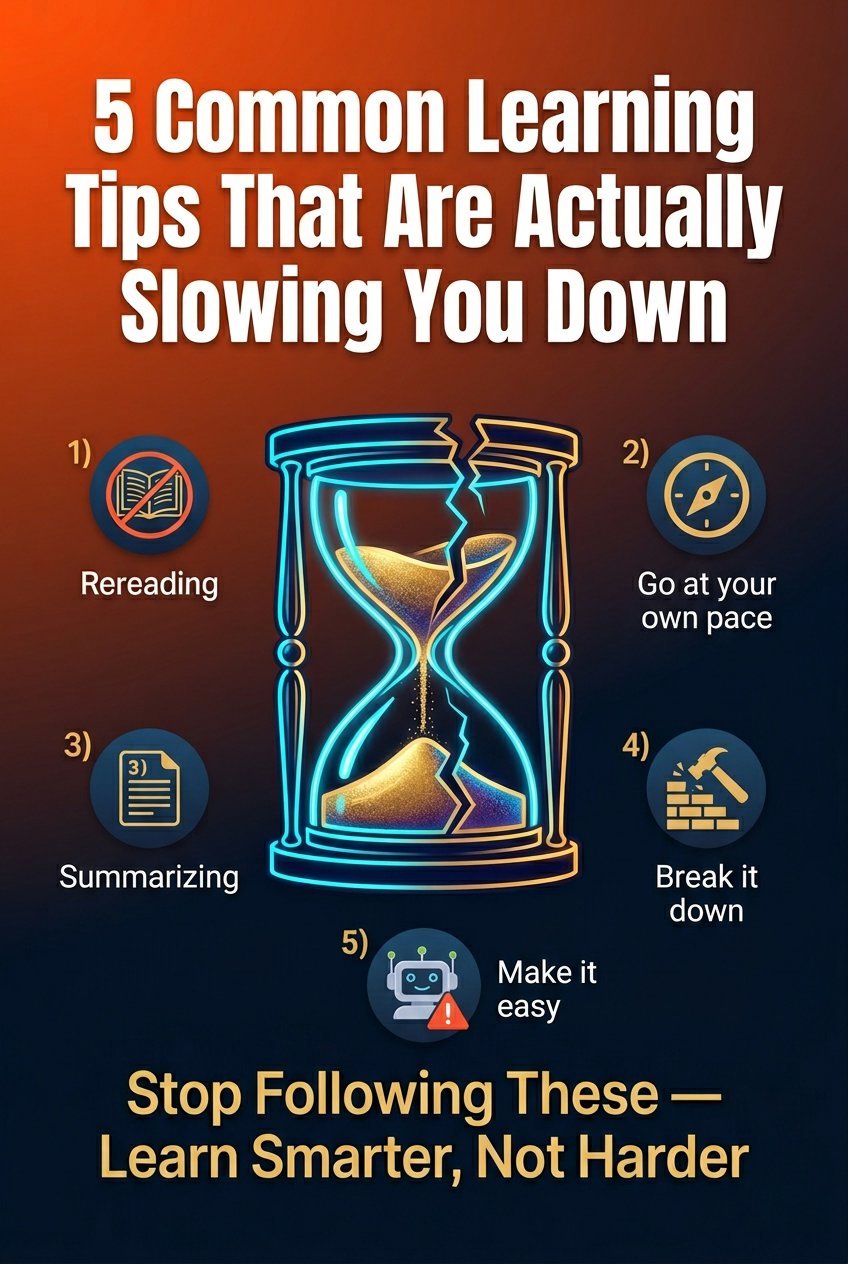
There are some pieces of learning advice that are so common and feel so intuitive that everyone follows it. But if you do follow it, it’s going to make learning any new skill or knowledge be twice as hard and take twice as long. As a learning coach now for almost 15 years, I’ve realized that a lot of people can learn anything faster just by not following this advice. So here are five pieces of learning advice that sound pretty good, but you need to stop following. And the last one is especially important if you ever use AI to help you with your learning.
Advice #1 — “If You Don’t Understand Something, Go Over It Again”
This sounds completely logical and intuitive, but it relies on this underlying assumption that the reason you didn’t understand it was because of insufficient exposure. But going over things again, even multiple times, is often a waste of time because the issue is that the process that you’re using to go over that material is systematically missing something. It doesn’t matter how many times you go over it unless the process and the approach you’re using to go over it changes, you’re just going to keep missing the same thing.
In fact, for me as a learning coach who’s trained thousands of people and seen this thousands of times, this for me is a diagnostic signal. When I see that someone is going over things again and again, rereading, rewriting maybe because they didn’t understand it the first time, it tells me two really important things. First, their process needs improving, but number two, most importantly, they’re not even aware of the fact that their process is broken. And nine out of 10 times, the part that is missing, the part that if you had, you would have understood it the first time, is context or, in research terms, the schema.
The Power of Context and Schema
Think about it like this. Imagine I send you a text message and I just say, “They finally did it.” If you read that, you have no idea what to make of it. Who is they? What did they finally do? Is this good news? Is this bad news? Should I be worried? You’re going to feel confusion. Your brain has lots of missing pieces and you’re trying to see where does this piece of information that I’ve just been given, the text message, where does that fit? And when your brain doesn’t know what to do with that information, not only are you obviously confused, but it’s not going to hold on to that information. You’re certainly not going to be able to use that information in anything because you have absolutely no idea how you might use it.
So now if I clarify that we’re talking about our mutual friend and they just got pregnant after trying for the last 3 years. Now, this has context. You know exactly how to think about this. Your brain has found a place for it to slot. Now, I find it helpful to try to visualize this. So if we imagine that this red circle is that new piece of information, our brain is trying to say, “Well, where does this fit?” means that you’re able to fit it inside a schema, a network of connected relevant information. So you can say, “Hey, this new piece of information fits right here because it connects to this.”
And so the confusion from new information doesn’t come from the information itself. The confusion comes from a lack of all of this. It’s because we’re missing the surrounding context that this piece is confusing. And so if we spend a little bit of effort figuring out a bit more of this context, you will find that new information slots in much more quickly, we’re able to understand it much faster, we’re able to hold on to that knowledge more easily and for longer, and things just click. But if you’re not deliberately trying to build context and build these connected schemas, then no matter how many times you go over it and over it again, you’re not really making any progress.
Imagine reading that text message multiple times, “They finally did it. They finally did it. They finally did it.” There’s nothing more to understand in that piece of information. All of the understanding has to come from what surrounds that information. This is exactly the reason why experts can learn new things within their domain faster than a beginner. Experts have more points that they can connect to to build context more quickly.
The Better Advice — Zoom Out and Ask Questions
So instead of, “If you don’t understand something, go over it again,” the better advice would be, “If you don’t understand something, zoom out and ask questions.”
Zooming out means looking at the big picture. Before you hone in on all the details of this piece of information you’re about to consume and try to understand, have a clearer understanding about where this fits in the grand scheme of things. It’s a useful strategy to deliberately map out the main concepts within this topic so that you see where the gap is that this information is meant to fill. It’s a lot easier to connect a schema when you can see the schema.
Asking questions means forcing your brain to see how it might be connected. Three questions that are often really useful for developing context and schema more quickly is, “Why is this important? How can I use and apply this information? And what is the main point of this in its simplest form?” When you actively ask these questions as you’re reading, it primes your brain to notice and pay extra attention to that type of information, which helps your brain form those connections more quickly.
If you’re already asking these questions and you’re still confused, then you might need to be asking a fourth question, which is, “What would I need to already know in order for this to become easier?” This is where AI tools can be really helpful because you can take what you’re trying to learn and you can generate a simplified layperson’s summary of the topic to rapidly build a big picture understanding in simple words without as much terminology. Or my personal favorite, putting some of that terminology into Google image search to see nice flow diagrams and charts that people have made about the topic. With this Google image technique, I’m leveraging off the fact that the brain is able to process visual information tens of thousands of times faster than written information. And so not only can I understand it faster, but it’s also, again, allowing me to visualize the schema.
Advice #2 — “Learn at Your Own Pace”
This is a great one because it sounds so compassionate. It sounds so learner-centric. Everyone is different, you shouldn’t put pressure on people, let them learn at the pace that they want to. And yes, it is respectful, but learning at your own pace often means you’re learning slower. And this all comes down to the theory of desirable difficulty, which was initially coined by a researcher called Bjork. And desirable difficulty basically says that there are certain things that require you to spend extra effort to overcome, but the effort is actually productive. And if we operate with a blanket rule that we should just avoid all difficulty, then we would avoid also the desirable difficulty, which is unproductive. The more easily and the more frequently you experience this desirable difficulty, the quicker you’re going to make progress towards your goals.
So what does this actually look like when someone’s trying to learn a new skill? Let’s say we have person A here. This person is going at their own pace and they’re trying to keep things comfortable and making sure that they are confident before moving on to each next stage of skill progression. So they’re going to start with the basics as you should, and then when they feel confident with the basics, they’re going to move up to the next level and so on and so forth. And they’re only moving up to new challenges when they feel confident at each previous step. Seems very reasonable and responsible.
But the problem is that learning is not so simple. Decades of research on skill acquisition have consistently shown that it is easier and faster to learn a new, especially complex, skill when there is a degree of failure and mistakes involved. Not only do the mistakes give you valuable feedback, but one theory is that when you do something incorrectly, it helps your brain figure out how not to perform a skill. When you do it correctly, your brain is learning the right way, and when you do it incorrectly, your brain is learning the limit or the edge of correct skill execution.
This also aligns with Vygotsky’s zone of proximal development, which says that people learn faster just beyond their current comfort zone and level of competence. So if our current level of competence is this inside this zone, we’re able to do it confidently with high levels of accuracy, then just beyond this zone in the zone of proximal development, which is where we want to be for maximum growth, it means that we are doing it correctly sometimes and incorrectly sometimes.
And so if someone is trying to stay here, then what their journey is going to look like will be like person B. This person is not optimizing for comfort or confidence. Instead, they are optimizing for feedback and challenges. They’re going to start with the basics until they feel like they can generally get it right. They’re then going to challenge themselves on a higher level and see what it’s like to just get it wrong. They’re going to come back to a lower level and reconsolidate that until they’re more accurate. And then they’re going to challenge themselves at all sorts of different levels and all sorts of diverse, different contexts. Sometimes they will do well. Sometimes they will make mistakes and fail. And each failure gives them more direction and insight onto how they should refine their practice and keep progressing.
And so even though it looks kind of messy and recursive, this is actually the nature of learning. And so this person’s skill growth is actually going to be incredibly rapid. On the other hand, with person A, they are unfortunately not going to be able to do this in reality. And actually what will happen is that they will stay with the basics for a very long time struggling to ever get true confidence because their rate of skill growth is much slower. And then when they go up to a higher level and they get a mistake, they’re more likely to take that as a signal that they’re not ready to get to that level and then they’re just going to stay here looping around at the basics without really progressing.
And the reality is that even though you’re optimizing for comfort and confidence, you’re going to feel neither of these things. You’re more likely to just feel demotivated at your lack of progress and confused as to why you do not seem to be getting better when you’ve apparently mastered the basics. And of course, what always happens when it is demotivating, most people will never get to a point of mastery because they will simply give up and say it is not for them.
The Better Advice — Learn at the Pace of Meaningful Mistakes
So, instead of learn at your own pace, the better advice is learn at the pace where you’re making meaningful mistakes. You’re making enough errors and mistakes to see the wrong way of doing things, but you are still consistently getting it right teaching you the right way of doing things. And anytime you feel comfortable and not really challenged with what you’re learning, it probably means that you’re going too slowly. That is, of course, if your goal is to learn as quickly as possible rather than just learning for leisure.
Now, one thing that speeds up your ability to figure out the right way of doing something is actually just having more knowledge. If someone teaches you, “This is the right way to do something,” you try to do it that way and you’re making some mistakes, knowing the theory of what you should do helps you to calibrate and self-correct. It reduces your trial and error and it improves your ability to give yourself feedback. And one of the issues commonly seen is that people often don’t know what the right way to use a learning strategy looks like in the first place. But the thing is that this doesn’t make sense. When you’re using a strategy designed to help you learn faster and save time, you should know what makes it effective and not effective. And you should know which strategies are worth practicing and which ones are a waste of time. And there is no reason you should not know that.
Advice #3 — “Summarize What You’ve Learned”
Now, if you’re a little bit more familiar with learning science, this one may confuse you a little bit because summarizing is a more active process. If you’ve written down a bunch of notes and you’re summarizing and condensing 10 pages into one page, that is involving your brain. It is generating more learning. The entire Cornell note-taking method is really based around the fact that you are summarizing. And while yes, summarizing is good compared to literally just not doing anything else and just like writing hundreds of pages of notes, it is generally not a very effective strategy. It’s also the reason the Cornell note-taking method is a little overrated.
In fact, there’s this great analysis that’s done by Dunlosky, who’s a very prominent learning researcher who found that summarization as a learning strategy is pretty low utility unless you’ve been trained on how to do it effectively, which by the way, most people are not.
How to Tell If a Learning Strategy Is Effective
So, here’s how you can tell if a strategy is going to be effective or not. Generally speaking, and this is oversimplifying a little bit, a learning strategy is going to be effective if it fulfills two requirements.
Number one, it improves your processing quality. So, processing quality means that when new information comes in, you are thinking about and organizing this new data in a way that allows those schemas and networks to be formed in your brain. Processing at a high quality often involves a decent amount of mental effort. This is the desirable difficulty. Learning the techniques and the strategies of processing to a high quality is not always intuitive and it does usually take training for most people. But as a quick rule of thumb, you can pretty much think about a high level of processing quality as something that builds really well organized networks of information and a low processing quality as isolated, often fairly repetitive methods that rely on either rote memorization or the intent to understand.
So, just to clarify this final point, intending to understand something doesn’t actually help you to understand it. Memory and understanding are byproducts. They are symptoms of when you have a organized network of information. So, if you focus on just creating well-organized networks of information, you will by default remember it and you will understand it very well. Just trying to memorize and trying to understand something are very ineffective ways of remembering and understanding. So, if a strategy forces the processing quality to be high, that’s one major tick in the box.
The second part is that it should involve some level of retrieval. And preferably, the retrieval should be free/un-cued. Retrieval is a scientific term for any time you use information from your memory. So, if you’ve learned something in the past and you’re trying to recall it, that’s retrieval. When you’re solving a problem, that’s retrieval. When you’re explaining something to someone, that’s retrieval. Anytime you are using knowledge that you have gained from memory for any purpose is retrieval. And free/un-cued retrieval means that you are using that knowledge without an external cue to access the memory.
So, a really good example of cued retrieval would be like flashcards. You have a question and then that question has an answer. The cue is the question. You see the question that prompts you to retrieve the memory. And even though cued recall can be advantageous in some situations, there are a lot of limitations primarily because of something called cue-dependent forgetting, which means that your memory becomes accessible only through this cue. So, when the cue changes, the memory becomes harder to access. So, for most knowledge where you need to use it in diverse applications, you don’t really want it to be locked down to just a specific cue. Now, if you do want to use that knowledge specifically for certain cues, then cued recall can be useful for that because it allows you to recall that memory very quickly as soon as you see the cue. So, if you are a first responder, you might recognize certain life-threatening cues and practice retrieving your knowledge from those life-threatening cues so that you are more efficient with your execution in real time.
And retrieval is crucial for learning because it trains your brain not only to access that memory quickly, but every time you access it, it creates an opportunity for your brain to strengthen that memory or, if you recall it incorrectly, to correct that memory. And so, when you have both parts together, it forms this really synergistic learning loop that pretty much you should, you know, anytime you’re learning something you want this to happen. Where you’re taking in new information, it is being processed to a high quality and then you are retrieving that information that trigger even deeper processing, which further consolidates that memory. So, this is like the most simple way of thinking about an effective learning strategy. And some learning strategies are mainly focused on this part, some are mainly focused on this part, but the best strategies have a bit of both.
Why Most Summarization Is a Waste of Time
So, let’s look at summarizing as a technique. Does summarizing force you to evaluate the information in organized networks? Not really. It is really possible to summarize, let’s say, 10 pages into one page just by removing unnecessary words, cutting down your sentences, turning things into bullet points, using shorthand. None of those things really force you to evaluate how everything connects together in a big picture. None of it is really creating strong context or schema and it’s not really improving your organization. As a result, a lot of the mental work in summarization happens to be pretty like editorial rather than analytical.
But does it at least use retrieval? Well, the way that a lot of people do summarization is open book. They’re looking at those 10 pages of notes and then they are summarizing that down into one page while looking at the notes. So, not only is it not free or un-cued, it’s not even retrieval at all. And so, the way that most people do summarization is frankly a waste of time.
The Better Advice — Summarize the Right Way
But I did say if you were trained on how to do it correctly, it is effective. So, instead of summarize what you’ve learned, we can turn that into summarize what you’ve learned the right way. And the right way to do it is, number one, activate the retrieval by making it closed book. Try to summarize everything from memory. And to drive up the processing quality, we need to start thinking in networks.
One great strategy you can use is something called sneaky plagiarism. So, you imagine that your original set of notes is the original text. And your job is to try to condense that down, but explain it and teach it in a way where even if you were to give this to the original author, they wouldn’t even recognize that it’s derived from their work. So, reorganize the material, rearrange the concepts, explain the connection between ideas in new ways, create a new framework or model of thinking about this that wasn’t present initially. This is more difficult, desirably difficult, but it also drives up that processing quality and forms much deeper and stronger memory. By the way, don’t plagiarize. Plagiarism is bad.
Advice #4 — “If Something Is Overwhelming, Break It Down Into Smaller Pieces”
Counter-intuitively bad learning advice number four. If something is overwhelming, break it down into smaller pieces. Now, this is great advice for productivity. If you’ve got lots of stuff to do, break them down into smaller tasks and it reduces your procrastination and makes it easier to get into flow. But this advice is not very good for learning, at least not on the way that most people interpret it. And actually, it all comes down to how you break it down.
A common example used academically when you’re learning in lectures is to break things down lecture by lecture. But these divisions are actually fairly arbitrary, especially if lecture one, two, and three are all talking about the same topic. If we remember this diagram from before, new information only clicks when it fits inside this larger schema, when it has that context. So now imagine that lecture one teaches this, lecture two teaches this, and lecture three teaches this. Well, now this new piece of information only has one other thing that it can connect to as opposed to before where it had one, two, three, four different opportunities.
And so the problem is that when we feel overwhelmed by a new topic, what’s really happening in our brain is that we are aware of the fact that there are all these individual pieces of information, individual facts, individual concepts, and we are aware of the fact that these things all connect with each other in some kind of way, but we don’t know what that connection is. And there are so many possibilities that it is overwhelming and it is confusing. And so if we handle this by saying, “Okay, I’m just going to break this down into this and then this and then this and then this and then this and then this.” You’re now actually making it harder for connections like this to form or like this to form because you’ve separated them. And you fall into this impossible trap where you have to see how these two things connect with the big picture when you have removed it from the big picture.
An analogy I like to give is if you’re solving a jigsaw puzzle and you feel like you’re overwhelmed because you don’t know where all the pieces fit, does the jigsaw get easier by taking a handful of random pieces out of the box and just trying to connect these pieces with each other? No, it gets harder, right? Unless you just so happened to pick up the handful of pieces that are literally all connected with each other.
The Better Advice — Break It Down Into Thinner Layers
And so instead of breaking something down into smaller pieces, the better advice is when you’re feeling overwhelmed with learning, break it down into thinner layers. Thinner layers means you look for which connections are the easiest to make. That becomes your foundation and then you layer your learning over it.
So if we look at all these individual concepts, instead of breaking them up like this, what we’re going to do is we’re going to start by scanning through everything first, looking through headings, titles, getting an overview. I often like to list out all the key concepts in a literal list on the side. And then I look through that list and I ask myself, “Which things seem related together off the bat? Where do I feel the most confident in creating some connections?” And it might be this concept and this concept. Those two feel related. And maybe I feel like this one is also related. And so I’m just going to start by building that out. And now that I’ve got this mini network, hey, this piece that before I didn’t see how it fit, now that I look at it, I feel like that could fit inside this connection here. And so I simply add that. And as this network grows, I’m giving myself more anchor points for this information to connect to. It’s getting easier and easier because I’ve actually built myself a schema to work with.
And hey, now that there are less jigsaw pieces in the box, there’s less concepts. I’m starting to see patterns that I didn’t see before. I can see how these things are related to each other. And before you know it, you’ve got everything organized and connected. Going from this to this in one go is going to feel incredibly overwhelming for anyone, for myself as well, which is why we break that process up into multiple layers.
Advice #5 — “If Learning Something Is Hard, Make It Easier”
Now, the final piece of learning advice that you should probably stop following is if learning something is hard, make it easier. And if you are using AI for your learning, this is incredibly important.
Here’s what I’ve covered so far. In order to produce high-quality knowledge that you can perform at a high quality with, you need to form schemas. Forming schemas involves processing things to a high quality, which involves mental effort that is desirable difficulty. It is this process of organizing the information, navigating through that desirable difficulty that causes your neurons to change and mold its relationships, which forms memory and knowledge.
When you have a project to deliver, a task to complete, questions to answer, when you need to have a certain level of expertise, you need that memory to be solid. You need your knowledge to be at that level. And the only mechanism that creates knowledge in the brain at that level is this processing and schema creation. When you bypass that, you are also bypassing the outcome and often instead creating an illusion of fluency or an illusion of competence.
And so when you’re learning something and it feels hard to learn, that’s normal. You’re probably feeling the overwhelm that is innate in trying to organize any complex piece of information. And all the advice that I’ve given you just before, these are strategies that allow you to navigate that overwhelm, to do that process. But if you believe that learning should feel easy, then you’re not going to use those processes because they involve that desirable difficulty. And you’re going to fall into the trap of what’s called the misinterpreted effort hypothesis, which is that people misinterpret that effort and desirable difficulty as a sign of ineffectiveness.
And so when you’re coming up against something overwhelming and your solution, the habit that maybe you’re forming is to chuck that into AI and to get it to just teach it back to you, the organization and the clarity you have gained is not yours. Your brain didn’t have to do any of the processing to get that organization. And so even if you understand it at that point in time, that memory is not going to stay and you’re not going to be able to use that knowledge like a real expert would. And you probably have already felt that process of understanding something that AI has explained to you and then a week or two later, it’s as if you never learned it. All you’re left with is the memory that once upon a time you remember understanding this.
And I can tell you, over the last year and a half, it has never been more of an issue than it is right now. Where it is now so easy to make learning feel easy using AI and to have this false sense of confidence in your learning because it felt easier to understand. But in reality, what I’m seeing a lot of the time is worse performance, worse memory, and a diminished ability to solve problems and use knowledge.
The Better Advice — Get Better at Learning Hard Things
And so let’s change that advice. Instead of if learning something is hard, make it easier, the better advice is if learning something is hard, get better at learning hard things.
Conclusion
If you want more strategies on how to learn hard things more efficiently, there are many resources available that go through learning to learn in much more detail and how you can actually build an entire learning system. Thank you so much for reading.