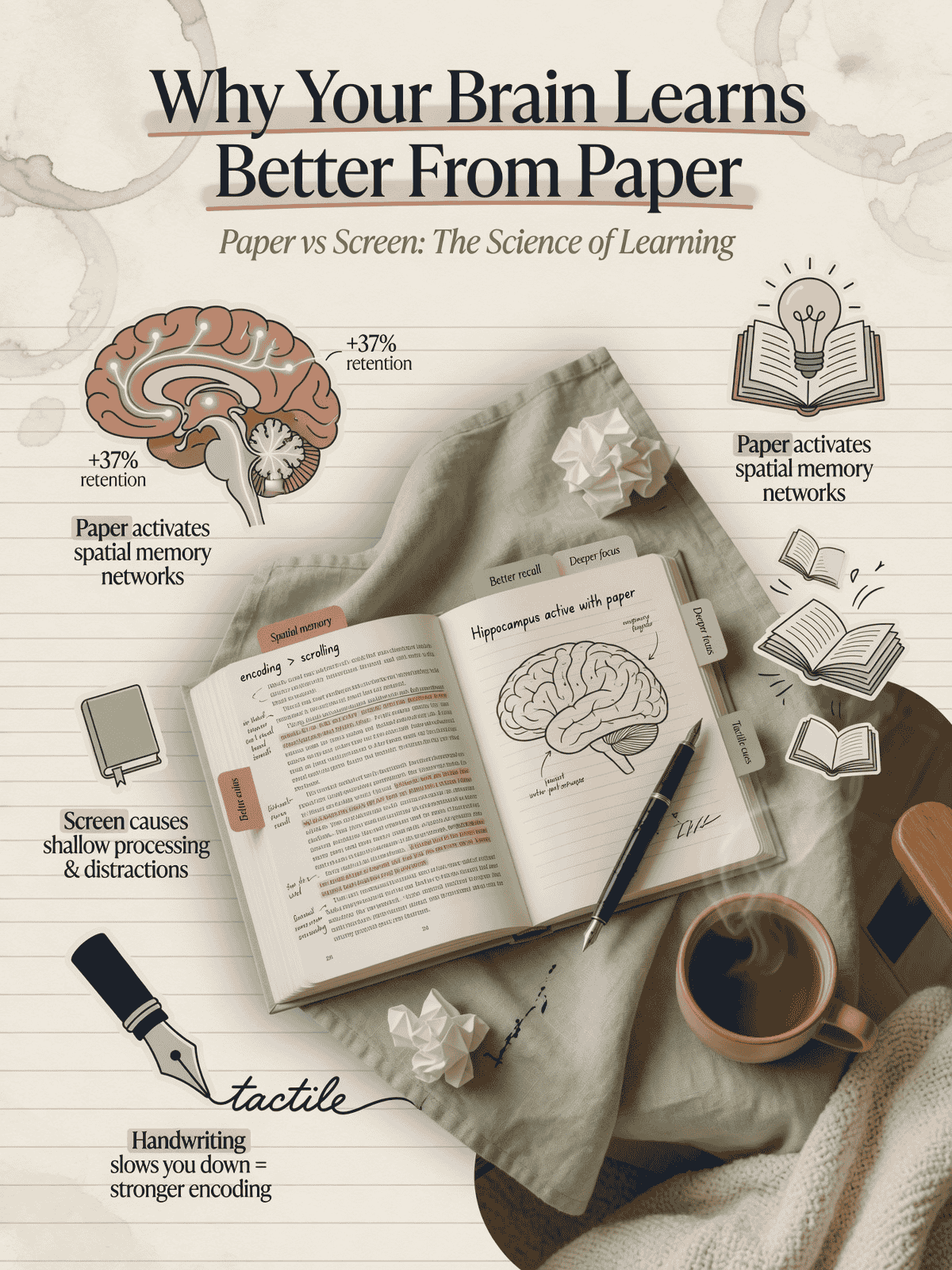
When I, as a learning coach, want to learn a new topic, one of the first things that I’ll do is go and buy a physical book. One of the reasons for that is because there’s a lot of research suggesting that your brain learns faster and easier from paper than it does from reading screen. But that is not the whole picture. The truth is that paper [music] is not necessarily better. And a lot of time we don’t have a choice. We cannot go and buy a book every time we need to learn something. Sometimes we do have to just read it on our phones or on our computers. So in this video I want to clarify what the research does say about learning from paper versus from screens, but really focusing on why paper is superior to screens in so many of these studies. Because once you understand why, we can then use that principle to make learning from screens just as effective. And at the end of the video I’ll summarize everything with what I personally do when I need to learn something and a book is not available.
What the Research Actually Says
So let’s just start with a really rapid recap of what the research says. Whether learning from paper is better or worse than learning from screens is something that has been debated since basically the invention of screens. There’s decades of research and what is surprising is that there is a small but consistent benefit of learning from paper. It appears that when you read something, your comprehension when you read it on paper is higher than when you read it from a screen. But this effect is not uniform across every condition. And this is where it gets interesting. When we look at in what situations is paper more superior to reading on screens, what we find is that firstly, there doesn’t seem to be a difference when we reading narrative or story-based content. So if you’re reading a novel on paper versus you’re reading a novel using like a Kindle or an e-reader or on a on a phone or a computer, there is no real difference in your comprehension levels. The effect of paper being superior has only been successfully replicated when we’re trying to learn from the text. Paper also seems to be more superior when there are time constraints on the reading. So, if you don’t give anyone any time constraints, then the effect of reading on paper versus reading on a screen seems to be negligible. Now, in a practical real-world sense, most of the time you’re reading something that is informational, that you’re learning something from, you’re also trying to do it fairly quickly. And so, the vast majority of the time you are under a time constraint, which would mean that paper is superior. We also see that the effect is larger when the text is longer, so greater than 500 words, especially if the text that you’re trying to read on screen requires you to scroll down the page. That becomes an important detail later on. And a really interesting, really problematic thing is that people who learn and read from a screen are more likely to be overconfident in their knowledge and comprehension than someone that is reading on paper. So, if you take the same text and you get one person to read it from paper, another person to read it from a computer monitor, the person who reads it on the computer is much more likely to think that their retention and level of knowledge is better than it truly is.
The 80-Book Household Advantage
And there’s also a developmental aspect. Children who grow up around books are much more likely to have better literacy and numeracy and even technological problem-solving skills into adulthood. This was found through a series of studies by researchers Evan Sakura, Kelly, and Treiman, who surveyed over 70,000 participants from 27 countries. And they found that children who grow up around lots of books receive approximately 3 years of further schooling than bookless children. This was independent of the parent education, occupation, and social class. As the number of books in the household increased, the benefit increased up until around 80 books, after which there was diminishing returns. The idea here, which the authors proposed, is that up until about 80 books in the household, you are establishing a culture in the house that this is a reading household compared to not having any books at all, which indicates this is not a reading household. And to put that advantage into context, being a reading household versus being a non-reading household has roughly the same benefit as having university educated parents versus unschooled parents. And across the 27 countries that this was studied over, the effect was found in all 27. Later studies also found that it wasn’t just three extra years of schooling, the test performance of the book children were greater than the bookless children, and those benefits extended into adulthood. This is a pretty famous study, and as you can imagine, there was a lot of discussion when this was published because the findings were so pronounced. And when you stop there, it’s easy to make the conclusion that learning from books is just better. And if that’s the conclusion you come to, you would be wrong. And the true, correct conclusion becomes apparent when we ask the question, “Why?” Why is it that in these studies, reading from paper seems to be superior to reading on a screen? And when we answer that question, we realize actually it has nothing to do with the paper at all.
Why Paper Wins: Four Key Reasons
There are four major reasons proposed in the research.
1. Fewer Distractions
The first one, when you read on paper, there are no distractions. When you read on a screen, you have to ignore ads, there might be messages people are sending to you, emails that you need to check. There are also micro decisions you need to make, like where on the page do I need to navigate? Where do I need to click into? And it may not seem like much, but your working memory is very, very limited. This is the part of your memory that’s responsible for actually making sense of information and learning it. So, even if a very small percentage of your brain is spent on ignoring these distractions and making these decisions, there is actually a very large effect on your brain’s ability to concentrate, focus, and learn. So, that’s the first and most obvious reason.
2. Spatial Memory Anchors
The second reason is because of spatial memory. Every time your brain learns something, it also saves this metadata along with the thing that you learned. So, for example, I took this photo here in Dubai. I was at the gym. I got to meet and chat with Prince EA. And when I look at this photo, and I click on more information, it gives me this metadata. It tells me when, what time, uh the phone that I used to take the photo with, where I was. And your brain does a very similar thing. When you learn a new fact or a concept, you learn that fact and concept, but you also store with it these context factors. And that helps to make this memory more unique. For example, if you learned this fact while you were with a friend sitting at a cafe, drinking a coffee and eating an almond croissant, then you may remember, when you’re trying to recall that fact, that you learned it in that context. Maybe the next time you go to the cafe and order an almond croissant, you remember that fact and concept as well. There are hundreds, if not thousands, of context variables that are saved with each memory item. And spatial memory is one of the strongest. I remember when I was in university, uh trying to answer a question in an exam, and I remember where on my page I had written the notes for this topic. But I couldn’t actually remember the information itself. This is an example where the spatial memory is there, but the item itself has actually decayed. And when you learn something on paper, it is much easier for your brain to make these spatial memory anchors. Because when you learn about this concept, it stays here, on this page. It’s not moving. When you look at this diagram and learn something from this, it stays here, relative to everything else on this page. This does not happen when we learn through a screen, because with a screen, you tend to scroll. Remember I said that that was going to be important later. When you scroll, it disrupts your brain’s ability to create these spatial memory anchors. And as a side note, this is also why mind mapping can be so helpful because it allows you to deliberately use your spatial memory to enhance your retention. So, that’s the second reason. Paper allows you to preserve spatial memory anchors.
3. Optimal Line Lengths
The third reason is to do with line lengths. So, if I have a piece of paper here that I’m reading, and this is my eye, and I am looking at the paper, then my line of vision is going to create this cone of around 5°, where I can actually focus on and comprehend uh what’s there. So, if the text on this page looks like this, these lines, then obviously my eye is going to have to move and sweep across to the right to read the entire line. And when it gets to the end of the line, it’s going to have to come down and start here and then sweep across again. But let’s say that you’re reading something on a website that’s not particularly optimized for learning from. And you’ve got a website that’s got text that looks like this. So, now your eye has to start here, and it has to sweep all this way, and then sweep all the way back here. And so, this sweep back to the next line becomes longer. And because it’s longer, it becomes less accurate. It takes you longer, it is harder for your brain to figure out what is the next correct line to come back onto. A part of your brain is now spent on not just understanding what it’s reading, but hunting for the next place on the page to put your eye. And again, it may seem small, but remember, your working memory is very limited. So, these small distractions, especially over a long reading session, really compound. This is the reason why on well-designed websites that are optimized for learning, the text width tends to be around 600 to 700 pixels wide. This allows roughly 50 to 70 characters to be on a single line, which is what research suggests is the optimum length. And so, we’ve covered three major reasons so far. Number one, that there are less distractions on paper. Number two, that paper allows more spatial memory. And number three, that the line width tends to be more optimum. So, if that’s the case, then using an e-reader, like a Kindle or a remarkable, should be just as good as reading on paper. And indeed, when we look at studies that examine e-reader or tablet reading compared to paper, we find that the difference in effect is much smaller, or in some studies, disappears completely. But, this doesn’t mean you have to go and buy yourself a Kindle or get yourself a remarkable, because there is a fourth reason for why paper has been seen to be so superior. And this is actually the most important reason of all.
4. The Screen Inferiority Effect
And it is something that in the research has been called the screen inferiority effect. Screen inferiority effect makes it sound like the screen is just bad. But in fact, what the screen inferiority effect states is that when we read things on a screen, on a computer, on a laptop, on a phone, most of the time when we are reading, we do not need to be reading very deeply. So, let’s look at the goal of typical screen reading. Normally, let’s say you’re reading someone’s text messages. Well, the goal after reading that is simply just to reply. Let’s say you’re reading an interesting news article. Sometimes the goal of that is nothing really. It’s just to feel something. It’s just to be entertained. Likewise, if we just reading captions on some Instagram reel. The overwhelming majority of the time where we are reading things on a screen, we don’t need to do anything with that information. And as a result, when we read things on a screen, we have developed a habit of superficial processing. We do not think deeply about what we are reading, we do not think critically about it, we do not engage our brain actively because there is no need to most of the time. But learning, learning is a totally different situation. When we learn, we have to retain that information. We have to build durable memory structures. We have to apply what we have learned to new context and to solve problems. These goals are very effortful and require deep processing. And what the screen inferiority effect says is that the reason we learn better on paper and learn worse with the screen is that we have the habit of just not using our brain when we are trying to learn from a screen. And this is actually the leading theory that the researchers from that children study where children perform better when they’re surrounded by books, this is the leading theory around why that effect exists because when you’re surrounded by books, it’s not just the presence of books like a magical totem, it is that when you grow up in that environment, you are encouraged to develop certain cognitive strategies. Cognitive strategies that you don’t need to develop if most of the reading you’re doing is online or in these types of contexts. And so, if this is true, if this is really the most important reason, then if you tell someone deliberately, “When you’re reading on the screen, think a little bit more deeply, think more critically, try and make connections.” Then you should see that the effect of paper versus screen disappears, and we do see that. Research that looks into that line of thinking shows that when you tell someone to just try and think a little bit deeper, their ability to learn and comprehend and perform reading from paper versus learning from a screen is no different. Now, it doesn’t mean that that person is also great at learning. If this person doesn’t know how to think deeply, if they don’t have great deep processing skills in the first place, then they’re not going to learn well whether it’s on paper or on screen. It doesn’t matter. The issue is not the medium, the issue is what goes on in their brain. And if you’re wondering, how good are my processing habits? Am I doing deep processing or not? Then I actually have a free quiz that you can take that will ask you a bunch of questions and give you a score on your deep processing habits as well as a couple other really important dimensions for effective learning. So, if you want to see where you are in terms of your existing level of deep processing, I’ll leave a link to that quiz in the description below.
Fluency Signals: Why We Feel Overconfident
Now, once we understand that the major difference between screens and paper is that we’re more brain dead on a screen, this also explains why we tend to be more overconfident when we learn from a screen. Because one of your brain’s primary indicators for how confident it feels is how many fluency signals it receives. And if you feel like you’re kind of not great at learning from both paper and screens, and you like forget what you learn all the time regardless, then this next part is going to be especially important for you. A fluency signal is basically your brain’s progress indicator. And I’m going to demonstrate this with this deck of cards. Most people, when they’re learning something new, they’re actually asking themselves only two questions. The first one is, how long does it take to cover all the material? The two variables here are how long it takes and the amount of material that is covered in that time. The second question is, do I understand what was covered? And this is sort of your quality indicator. If you can cover a large amount of material in a short time while you understand what you covered, then most people would say that they have learned very effectively. And so where mentally in our brain, these are our fluency signals, well at least some of them. And so here’s what happens. We have a passage of text that we’re reading and assume that each of these cards is like a fact or a concept or a paragraph that we’ve read. So the first one, we read this and we ask ourselves, do we understand this? And if we understand this, we tick that off and we move on to the next one. Do we understand that? Yep. Do we understand this? Yes. Do we understand this? Yes. So we can recognize these cards straight away. It takes a split second for you to understand what the card is that I’m laying down. And so in a matter of seconds, I’ve been able to cover all four of these and I’ve understood and recognized all four of them. We feel good about our learning because we’re getting lots of these fluency signals. When we read on a screen, we get even more of these fluency signals because on a screen often there is a scroll bar, which is literally a progress bar of how much you have covered. So every time you scroll, that is a fluency signal that’s saying, I have covered more material. Maybe there’s a link to click and you click on that link. That’s another little fluency signal telling your brain that you are covering more stuff. If I’m reading through this book, I may stay on this two sets of pages for 15, 20, 30 minutes just trying to wrap my head around it. And all of that time, I’m not getting these really clear fluency signals. And so for my brain, it feels like I’m moving really slowly, I’m learning less effectively. But the thing about learning and building memory is that your ability to achieve these goals, retain what you learn, and apply what you’ve learned has very little to do with any of these things that we are tracking. It doesn’t matter if you cover it, it doesn’t really matter how long it takes you, and whether you understand something is not a good indicator of whether you will actually remember it and then be able to apply it later. And we could demonstrate that right now based on the fact that these four cards, even though you all understood each of these cards, if I flipped these upside down and got you to draw them out from memory, I bet you do not accurately remember what the heart or the club looked like, or what the jack exactly looked like. This is the difference between recognition, which is a strong fluency signal, and recall, which is our ability to actually apply and use that memory in the future. And so if these are not the right questions to be asking ourselves or using to measure progress, what are the right questions? Well, the right questions are to build connections. It’s to create meaning and sense out of the information. Memory is built through finding patterns. For example, this is an eight of hearts. I’m comparing and contrasting this eight from this eight. I can see that the gap between the heart and the eight is the same on these four corners as it is here. But the gap between the clubs is narrower than the gap between the hearts. That tells me that this club icon must overall be a little bit bigger and take up more space. I’m deliberately trying to find these similarities and differences and find patterns that can help me build this stronger, more connected memory. As a result, our speed is going to go down, but on the other hand, it becomes faster and easier to actually hit the goals that we have set out for ourselves. And when you don’t understand that asking these questions does not help to build real memory, that’s when we become overconfident because we think that the fluency signals translate to performance signals. And a lot of the time to learn faster, we have to tell our brain to slow down and think more deeply at each step.
My Personal Approach: Books vs. Screens
So, what do I actually do? When do I read using a book? When do I learn using a screen? And if I’m reading on a screen, how do I optimize that? So, the first thing is if I’m learning something significant, I think I’m going to be spending hours, days, weeks even learning about this thing, then I’m going to go and buy a book. Why buy a book when I’ve just explained that you can just tell yourself to think more deeply about it and that negates the benefit of paper. For me, I buy the book because it’s just easier. When I learn from the book, a lot of the things are optimized for me. The line length, the lack of distractions, the spatial positioning, these things are just there on paper to begin with. And yes, I can use strategies to overcome that so that the difference is negligible, but if I don’t have to, then it’s easier just to use a book, especially if I’m going to be spending hours and hours and hours using this book as a learning reference. And that is why my bookshelf grows over time. Now, if I’m not learning through the book and I’m learning something on a screen, then I make sure there’s only one window open on that monitor. That window is narrow. There’s just a window in the middle and I manually bring that width down until I feel like the line width is roughly that 45 to 70 characters in width. And if I start reading something online and I realize I’m going to be reading this for a while, I will actually print it out. And I do this even though I own a Kindle and I used to own a remarkable and I used them both extensively for years. The reason I well sold my remarkable and actually don’t use my Kindle at all anymore is because one of my non-negotiables when I’m reading and learning anything dense is that I need to be able to go back and forth very quickly. So, I need to be able to literally have an idea and then think Hmm, I remember this previously, have my hand here and flick back and then go back and forth like this. I need to be able to do this very quickly without friction and I found that process was very well, had a lot of friction doing it on an e-reader. And for me personally, at least, I have found that there is a sensory benefit of learning from books. Like I said, that context memory that’s also stored with what you’re learning. Just the And this is sounds so nerdy, but just the smell of the book and just the feel of the paper in my hands is a more comfortable learning experience for me that I just personally prefer, but there is also some newer research that’s starting to come out now that suggests that there may actually be this kinesthetic advantage of having paper in your hand and you’re smelling the paper that may actually improve performance, but I don’t know what that research is going to say, but I suspect it’s going to be a pretty minor benefit. For me, it’s just personal preference. Now, I’m not hating on e-readers or remarkables or anything like that at all. I’m totally open-minded and I probably will go back to experimenting with them more in the future. It’s just that for me, I just found that I would rather carry a book around with me even though it’s more space and weight.
Final Verdict
So, does your brain learn better from paper? Generally, yes. Does that mean you can’t learn effectively from a screen? Absolutely not. Otherwise, thank you so much for reading ,and I’ll see you in the next one.